
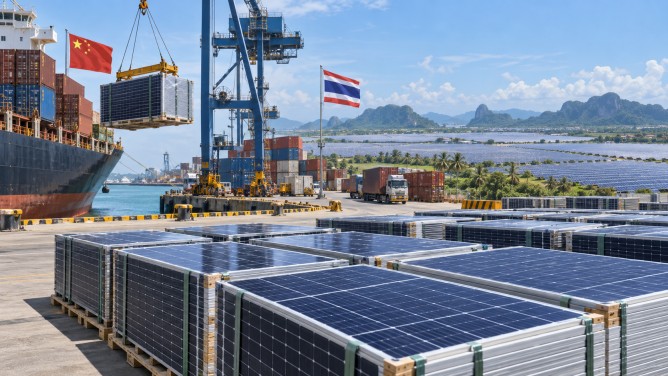
Thailand’s solar panel imports have seen a remarkable increase, surging 88.7% year-on-year to reach $426.7 million in the first seven months of 2026, according to data from the country’s Ministry of Commerce and Customs Department. Significantly, China was the predominant supplier, accounting for 99.3% of these imports, with shipments from China totaling $423.9 million, marking a 107.1% rise from the previous year.
This surge in imports is closely linked to Thailand’s ambitious household solar installation initiative, which aims to subsidize solar installation costs by up to THB50,000 per household. The program initially targets one million households, with plans to potentially extend this to 1.5 million, thereby promoting both rooftop and ground-mounted solar installations.
In addition to expanding solar panel imports, the Thai government is exploring strategies to bolster domestic solar manufacturing capabilities. Collaborations with the Ministry of Labour are underway to enhance workforce skills in solar panel assembly, installation, and maintenance. Concurrently, discussions with the Board of Investment are focusing on reducing tariffs on production materials that are not readily available within the country.
The overarching goal of Thailand’s solar initiative is to lower electricity costs for households while supporting the growth of a sustainable clean-energy supply chain domestically. By fostering both import and local production, Thailand hopes to position itself as a key player in the renewable energy sector, aligning with global trends toward sustainable energy solutions.
While China’s dominance in the supply chain is evident, other regions like Singapore and Hong Kong play a minor role, each contributing approximately 0.3% to Thailand’s total solar panel import value. This dynamic underscores the critical role of international partnerships in Thailand’s energy strategy, as the nation seeks to balance import reliance with domestic capability development.